
Ask climbers in Huaraz where they stood on their first glacier, and a surprising number will say Mateo. It’s a one-day climb, it starts from a road at 4,736 m, and it ends on a real snow summit at 5,150 m with Huascarán, Peru’s highest mountain, filling the horizon. That’s higher than Mont Blanc (4,806 m / 15,767 ft), the roof of the Alps, and you get there and back in a single day. For many of our clients it’s the day they discover that mountaineering is something they can actually do.
In short: Nevado Mateo is a 5,150 m (16,896 ft) peak in Peru’s Cordillera Blanca, climbed in a single day from Huaraz. You drive about 2.5 hours to the Punta Olímpica tunnel (4,736 m / 15,538 ft), hike about two hours up a rocky moraine to the glacier, then rope up and climb 30 to 50 minutes on snow to the top, about 340 m higher than Mont Blanc, all in one day. The route is graded F (easy), and no previous climbing experience is needed, just good fitness and two to three days of acclimatization. With Andean Raju it costs US$ 90 per person, including private transport, a certified mountain guide and all technical equipment.
The main climbing season runs from April to November; since 2024, Huascarán National Park has twice closed Mateo from December to March. We’ve been guiding it since the route became popular, and it’s the peak we recommend most often to people who want to try mountaineering before committing to something bigger. What follows is what we’d tell you over coffee in Huaraz before you sign up.
In this guide:
- Nevado Mateo at a Glance
- Where Is Nevado Mateo?
- A Young Route With a Family Name
- Is Mateo Right for You?
- The Climb, Hour by Hour
- How Hard Is Nevado Mateo?
- Acclimatization: The Part Most People Skip
- When Is the Best Time to Climb Mateo?
- How Much Does It Cost?
- What to Bring
- How to Choose a Guide or Agency
- Why Book With a Licensed Agency
- Mateo vs. Vallunaraju vs. Pisco: What Comes Next
- Common Mistakes
- Nevado Mateo FAQ
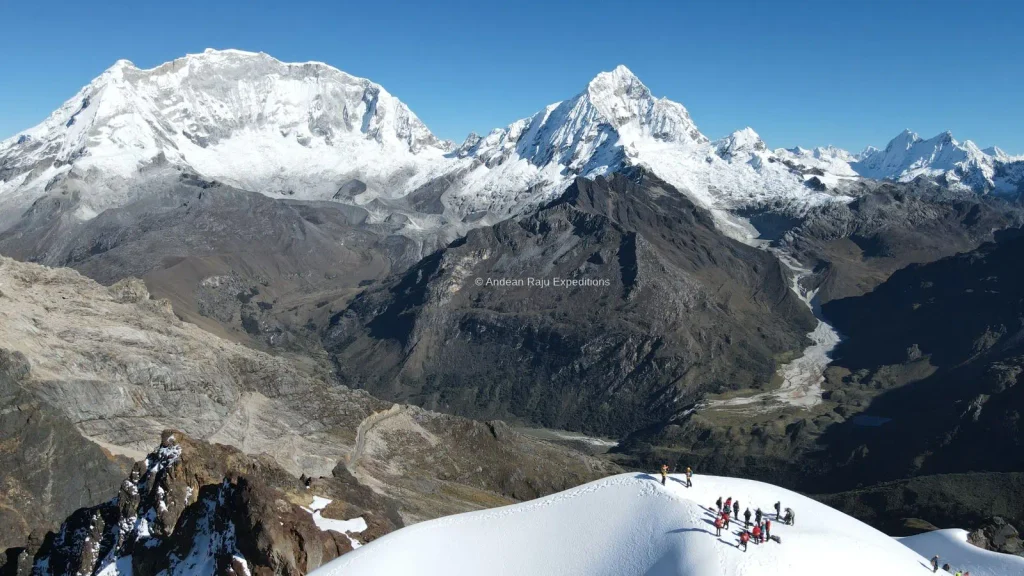
Nevado Mateo at a Glance
| Summit altitude | 5,150 m (16,896 ft), higher than Mont Blanc |
| Starting point | Punta Olímpica tunnel, 4,736 m (15,538 ft) |
| Elevation gain | About 415 m (1,360 ft) on foot |
| Distance | About 1.5 km (0.9 mi) from the trailhead to the summit; 3 km (1.9 mi) round trip |
| Duration | 1 day: hotel pickup in Huaraz at 2:30 am, back in the early afternoon |
| Climbing time | About 2 hours on moraine terrain to the glacier, then 30–50 minutes on the glacier to the summit |
| Difficulty | F (easy) on the alpine scale; no experience needed |
| Acclimatization | Minimum 2–3 days in Huaraz |
| Season | April to November. Since 2024 the national park has twice closed it from December to March. Best conditions May to September |
| Guide ratio | 1 certified mountain guide for every 3 climbers |
| Park fee | S/ 30 (about US$ 8), one-day ticket to Huascarán National Park |
| Guided climb | US$ 90 per person with Andean Raju |
Where Is Nevado Mateo?
Mateo belongs to the Contrahierbas massif, inside Huascarán National Park, at the head of the Ulta valley in the province of Carhuaz. It rises just above the Punta Olímpica pass, facing Chopicalqui and the twin summits of Huascarán.
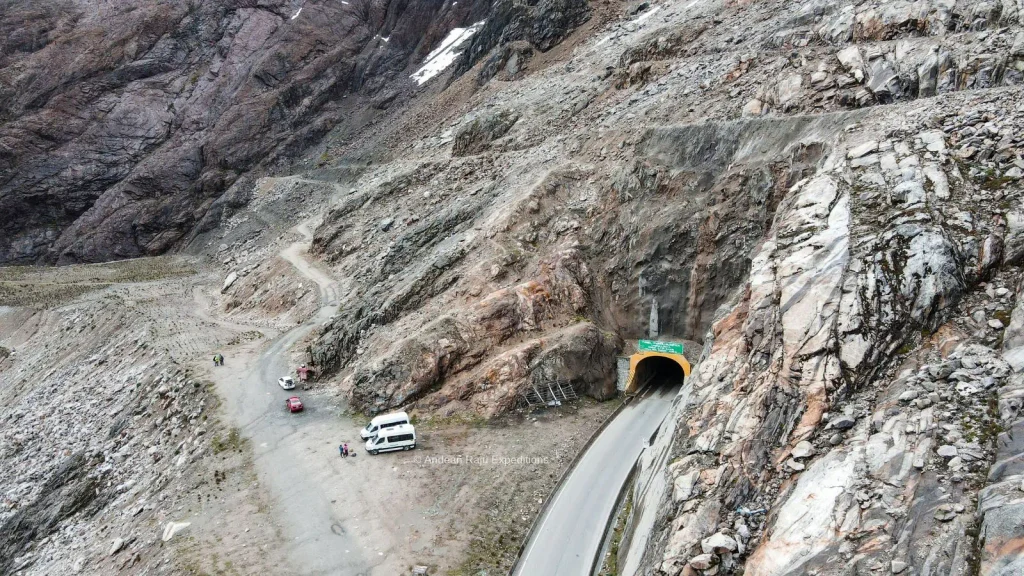
Your base is Huaraz (3,050 m / 10,000 ft). From there the road heads north along the Callejón de Huaylas to Carhuaz, then turns east and climbs the Ulta valley in a long series of switchbacks to the Punta Olímpica tunnel, one of the highest road tunnels in the world. The trail starts right beside the road, which is exactly what makes Mateo so accessible: you gain most of the altitude by van, not on foot.
A Young Route With a Family Name
Unlike most peaks in the Cordillera Blanca, Mateo’s climbing history is recent. In 2015 a rope team from Huaraz, led by a guide from the Peruvian Mountain Guide Association (AGMP), explored and opened the route. They named the mountain Mateo in honor of the son of a client who was climbing with them. Within a few seasons it became the most popular first summit in the range, thanks to its short approach from the road.
Is Mateo Right for You?
Answer these four questions honestly before you book:
- Can you walk uphill for two to three hours? Mateo isn’t long, but every step is above 4,700 m. If you can hike a steep day trail at home without trouble, you’re in good shape.
- Can you spend two or three days in Huaraz first? This matters more than fitness. Going straight from the coast to 5,150 m is the most common reason people turn back.
- Are you OK with an early, cold start? We pick you up at 2:30 am, and the first hours on the glacier are often below freezing.
- Do you want to learn, not just summit? Your guide will teach you to walk in crampons, use an ice axe and move on a rope. That’s the real value of Mateo.
Four yeses, and Mateo is a great first peak. If acclimatization time is the problem, do a day hike like Laguna Churup or Laguna 69 first and climb Mateo a couple of days later. Participants must be 18 or older.
The Climb, Hour by Hour
Every group is different, but a typical Mateo day looks like this:
| Time | What happens |
|---|---|
| 2:30 am | Pickup at your hotel in Huaraz in our private vehicle. |
| 2:30–5:00 am | Drive north to Carhuaz, then up the Ulta valley to Punta Olímpica. Most people sleep. |
| ~5:15 am | Gear up at the trailhead and start walking by headlamp. |
| ~7:15 am | Reach the glacier after the moraine. Equipment check, crampons on, rope up. |
| ~8:00–8:30 am | Summit, 5,150 m. Rest, drink, photos and the view. |
| ~10:00 am | Back at the road after descending the same route. |
| Early afternoon | Back in Huaraz, with a stop in Carhuaz for its famous homemade fruit ice cream. |
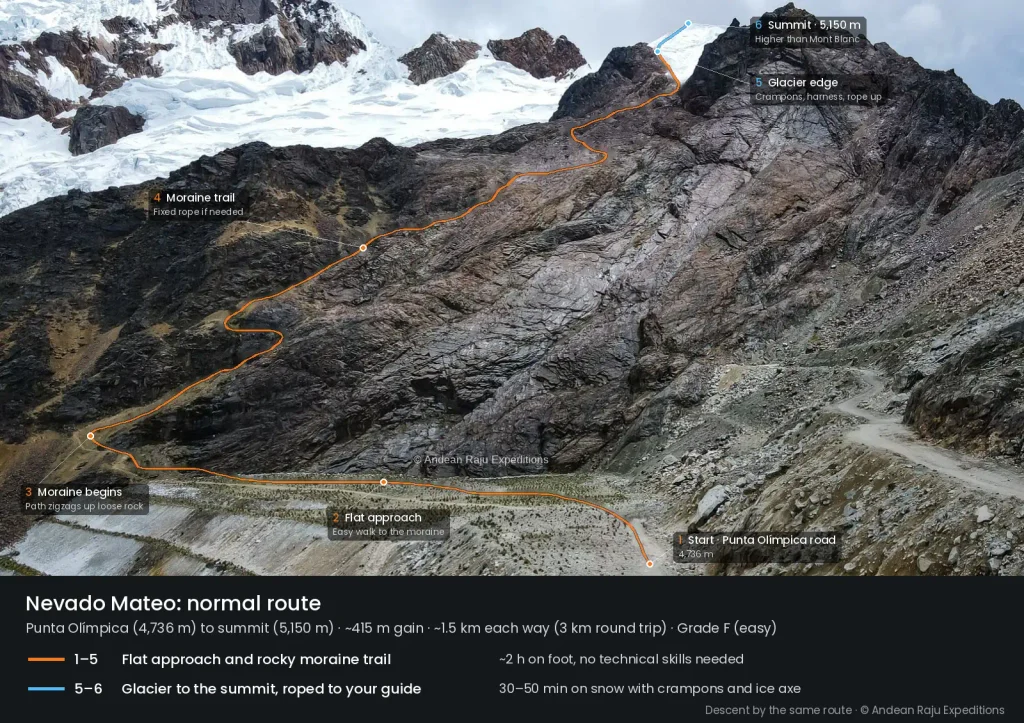
1. The Approach and Moraine (about 2 hours)
The first stretch from the road is almost flat, leading to the base of the moraine. Then the slope steepens over loose rock. It isn’t technical, but if you’ve never hiked on rough ground it can feel awkward, and your guide will fix a rope in the steeper spots if needed. Go slowly here: people who rush the moraine pay for it on the snow.
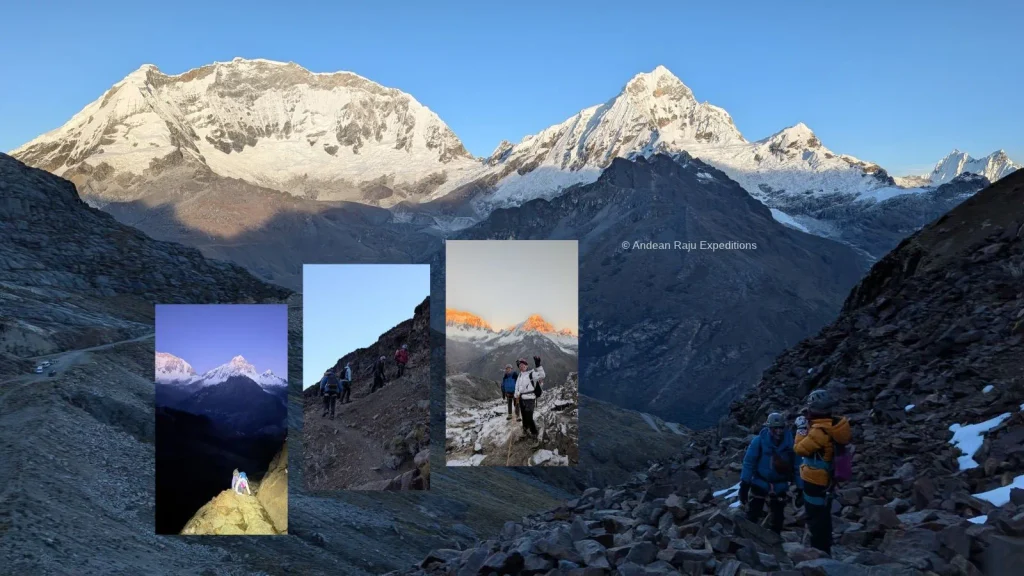
2. The Glacier (30–50 minutes)
At the glacier’s edge your guide checks every harness, crampon and helmet, then ties the team onto a rope, with no more than three climbers per guide. Before you start, you’ll practice the basics: walking in crampons, using the ice axe for balance and keeping the rope at the right tension. The snow slope is steady and moderate, and this is where the sun usually rises over Chopicalqui behind you.
3. The Summit
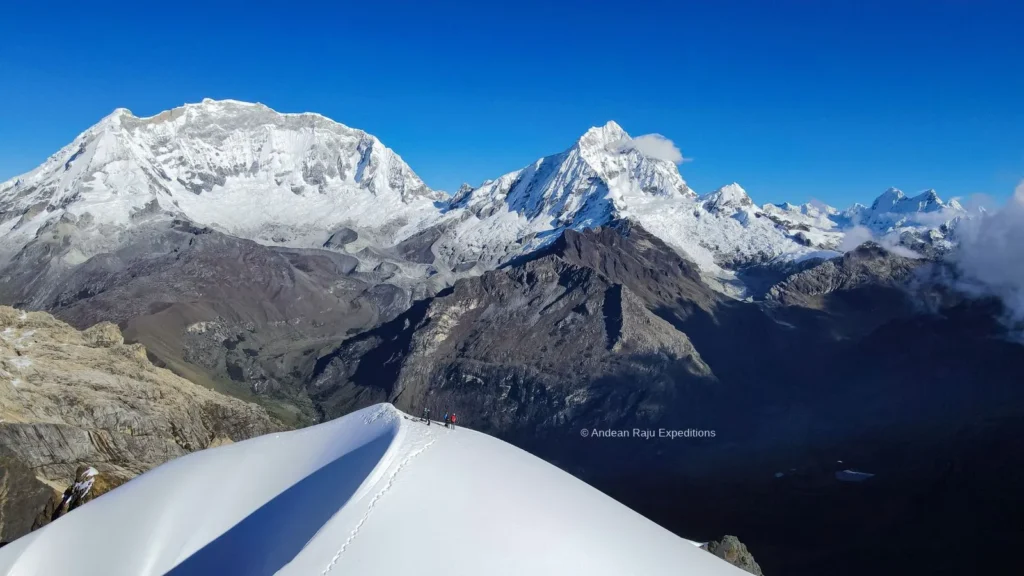
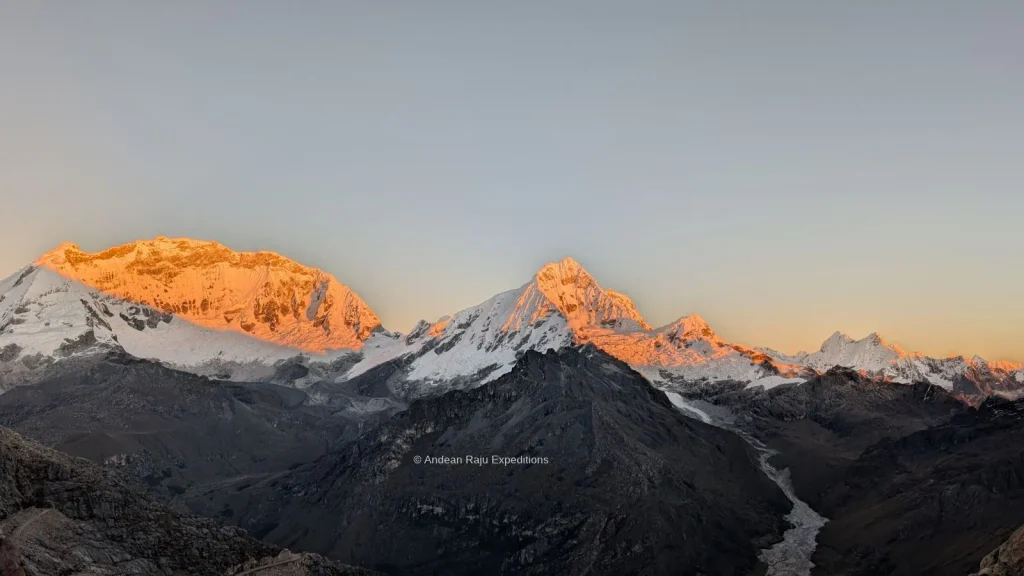
The top is a small snow summit with a 360° view. On a clear morning you look straight across at both summits of Huascarán (6,768 m), with Chopicalqui, Ulta, Contrahierbas and Chacraraju around you, and the turquoise lakes of Cancaracá and Shulla far below. It’s the same view climbers on much harder mountains work days for.
4. The Descent
You come down the same way. Descending on snow is where tired legs make mistakes, so your guide keeps the rope on until you’re off the glacier. How long it takes depends on your energy; most groups are back at the road within 1.5–2 hours of leaving the summit.
How Hard Is Nevado Mateo?
On the UIAA/alpine scale Mateo is graded F (easy), one of the easiest glacier summits in the Cordillera Blanca. There’s no vertical ice and no night in a tent. What makes it demanding is the altitude: at 5,150 m there’s roughly half the oxygen of sea level, so even a gentle slope feels hard.
Higher Than Mont Blanc, in One Day
Mont Blanc, the highest mountain in the Alps and Western Europe, stands at 4,806 m (15,767 ft) and is usually climbed over two days with a night in a mountain hut. On Mateo you stand about 340 m higher, at 5,150 m, and you’re back in Huaraz for a late lunch. That’s possible because the road to Punta Olímpica does most of the climbing for you, and it’s why so many European climbers come to Huaraz to set their personal altitude record.
Think of it this way: if the same climb were at 2,000 m, it would be a pleasant morning walk. At Mateo’s altitude it’s a real effort that most reasonably fit people can manage, provided they’re acclimatized. The part that surprises people most isn’t the glacier but the moraine, especially if they’ve never walked on loose rock.
Acclimatization: The Part Most People Skip
The most common mistake we see on Mateo isn’t technical. It’s arriving in Huaraz on Monday and trying to climb on Tuesday. You drive from 3,050 m to 4,736 m in a couple of hours and start walking immediately, so your body has no time to adjust on the way up.
Our minimum is two to three full days in Huaraz before the climb, ideally with one or two acclimatization hikes. A good plan:
- Day 1: Arrive in Huaraz in the morning and rest. Short walk around town, lots of water, coca tea, no alcohol.
- Day 2: Easy hike to Laguna Wilcacocha (about 3,700 m).
- Day 3: Laguna Churup (4,450 m), Laguna 69 (4,600 m) or Laguna Parón.
- Day 4: Climb Nevado Mateo.
If you’ve just finished a multi-day trek like Santa Cruz or the Huayhuash, you’re already acclimatized and can climb Mateo straight away.
When Is the Best Time to Climb Mateo?
The main climbing season on Mateo runs from April to November. Since 2024, Huascarán National Park has closed the mountain twice from December to March, the heart of the rainy season, based on studies by specialists from INAIGEM (Peru’s National Research Institute of Glaciers and Mountain Ecosystems) and the Casa de Guías (Huaraz’s mountain guide association). The closures are for safety reasons and to give the glacier time to regenerate. Heavy snowfall, poor visibility and a softer, more crevassed glacier make those months riskier, and a few months without hundreds of boots and crampons lets the snow and the moraine recover. The park decides each season whether to close Mateo, so if you’re planning a trip for December to March, ask us for the current status before you book.
| Months | Conditions |
|---|---|
| April and early May | The end of the rains. Fresh snow on the glacier, green valleys and fewer climbers. Afternoon clouds are still common. |
| May to September (dry season) | The most stable weather, clear mornings and the best views. Cold at dawn, often below –5 °C (23 °F) on the glacier. |
| October and November | Still good climbing, with clear mornings and clouds building from late morning. The early start matters more. |
| December to March | Closed twice since 2024 so the mountain can rest and regenerate. Ask us for the current status. |
If Mateo is the main reason for your trip, June to August gives you the best odds of a clear summit view. If you’re visiting Huaraz between December and March, ask us about day hikes and treks that run in the rainy season.
How Much Does It Cost to Climb Nevado Mateo?
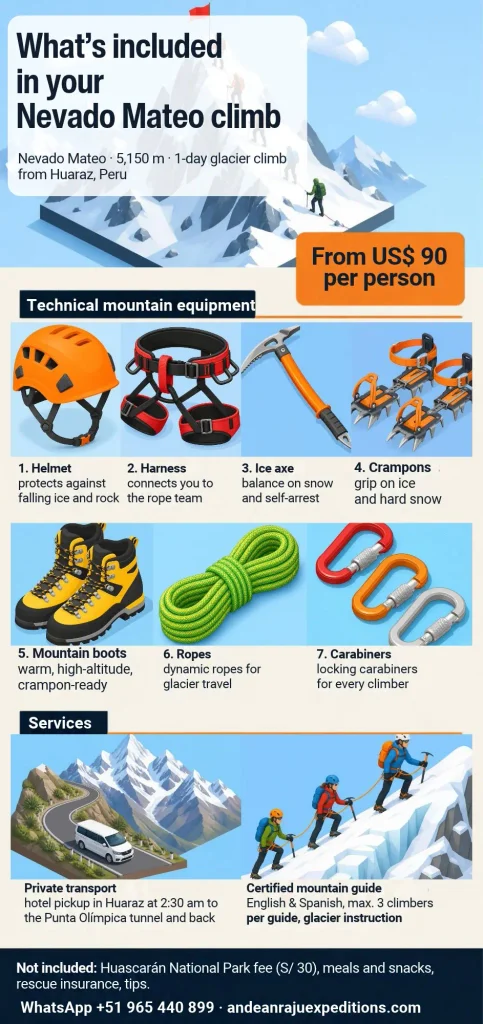
Guided with Andean Raju: US$ 90 per person. It includes:
- Private transport Huaraz – Punta Olímpica – Huaraz, with hotel pickup
- A certified mountain guide (English and Spanish), 1 guide for every 3 climbers
- Technical equipment: mountaineering boots, crampons, ice axe, harness and helmet
- Instruction on the glacier and advice before the climb
- First-aid kit
Not included: Huascarán National Park entry (S/ 30, paid in cash), breakfast, box lunch and snacks, accident and rescue insurance, hotels in Huaraz and tips. We have an agreement with Global Rescue that gives our clients a preferential price on rescue cover; ask us when you book.
See the full details of our Nevado Mateo climb →
What to Bring
We supply the technical gear. You bring:
- Synthetic long-sleeve base layers and trekking trousers (no cotton)
- A fleece and a warm down jacket
- A windproof and waterproof jacket
- Warm gloves (wool gloves cost about S/ 10 in Huaraz), a wool hat and a buff
- Warm, thick socks
- Glacier sunglasses (category 3 or 4), sunscreen and lip balm
- Headlamp with fresh batteries
- 1.5–2 liters of water, a packed lunch and energy snacks like chocolate
- A small backpack (20–30 liters)
- Cash for the park fee and your passport
Pack light: every extra kilo feels heavier at 5,000 m. And bring your rubbish back down in your pack. Missing something? You can rent clothing and gear from us in Huaraz.
How to Choose a Guide or Agency
Prices for Mateo vary a lot in Huaraz, and the cheapest offer usually saves money on the things that matter on a glacier. Before you pay, ask:
- Who is the guide, and what are their qualifications? On a glacier you need a certified mountain guide, not a trekking guide. In Huaraz that can mean an international qualification (IFMGA or UIMLA) or Peru’s official mountain guide certification.
- How many climbers per guide? On a rope, three climbers per guide is a sensible maximum. More than that and the guide can’t react fast enough if someone slips.
- What’s the condition of the equipment? Worn crampons and boots that don’t fit ruin more climbs than bad weather.
- Is it a legally registered agency? A registered agency is legally responsible for your trip and can organize a rescue, transport and medical care if something goes wrong. An informal guide working alone may not have the resources or the obligation to do so.
Ask for the company’s registration details before you pay, and make sure your contract names both the agency and your guide.
Why Book With a Licensed Agency
Mateo’s easy grade and short approach make it tempting to hire the cheapest offer you find. Every season we hear from travelers who did exactly that and regretted it. On a glacier at 5,150 m, the difference between a formal agency and an informal operator isn’t comfort; it’s safety. Here’s why we strongly recommend booking with a legally registered agency:
- Fewer accidents. Formal agencies are required to work with certified mountain guides, keep safe guide-to-climber ratios and use equipment in good condition. Most accidents on easy peaks come from untrained guides, overcrowded ropes and worn gear.
- Someone responsible when things go wrong. A registered agency has a legal representative and is accountable for your trip. It can organize a rescue, emergency transport, medical care and insurance paperwork. An informal guide working alone may not have the resources or the obligation to do so, and in the worst cases travelers have been left without support after an accident.
- Protection against scams. Touts outside the bus terminals and in the streets of Huaraz sell tours that are cheaper on paper, then change the guide, the vehicle or the date, add hidden charges, or never show up. Some travelers have paid in advance to “agencies” that don’t exist.
- Clear conditions. A formal agency gives you a written contract, a receipt and clear terms on what’s included, cancellations and refunds.
- A fair contribution. Licensed agencies pay taxes in Peru, pay park fees properly and respect the seasonal closures that protect mountains like Mateo.
Before you pay anyone, ask for the company’s registration details, check its reviews, and make sure your contract names both the agency and your guide. And never pay in full to someone who approaches you at the bus station.
Mateo vs. Vallunaraju vs. Pisco: What Comes Next
Many of our climbers use Mateo as a stepping stone. Here’s how it compares with the next peaks on the list:
| Peak | Altitude | Duration | Best for |
|---|---|---|---|
| Mateo | 5,150 m (16,896 ft) | 1 day | Your first glacier and first 5,000 m summit |
| Vallunaraju | 5,686 m (18,655 ft) | 2 days | A first overnight climb with a high camp |
| Pisco | 5,752 m (18,871 ft) | 3 days | A classic glacier climb with a longer summit day |
If Mateo goes well, you’ll know whether you enjoy life on a rope, and you’ll be better acclimatized for the next one. Ask us about combining two climbs in one trip.
Common Mistakes on Nevado Mateo
- Not acclimatizing. By far the biggest one. Give yourself two to three days in Huaraz first.
- Starting too fast. The flat start and the moraine tempt people to rush, and they run out of energy on the glacier. Walk slowly enough to control your breathing.
- Stopping too often. Constant stops for photos or rest chill you and wear you out more than a slow, steady pace.
- Underestimating the cold. At dawn on the glacier it’s often well below freezing. Bring proper gloves, not just liners.
- Forgetting sun protection. Sunburn and snow blindness happen fast on a glacier, even on cloudy days.
- Hiding symptoms from your guide. A headache mentioned at the trailhead is easy to manage. The same headache ignored until the summit slope isn’t.
Nevado Mateo FAQ
How high is Nevado Mateo?
5,150 m (16,896 ft). The climb starts at 4,736 m (15,538 ft) at the Punta Olímpica tunnel, so you gain only about 415 m on foot.
Can a beginner climb Nevado Mateo?
Yes. Mateo is graded F (easy) and is one of the best first peaks in Peru. You don’t need any previous climbing experience: your guide teaches you to use crampons, an ice axe and a rope on the day. What you do need is good fitness and two to three days of acclimatization.
How long does the Mateo climb take?
It’s a full day from Huaraz. We pick you up at 2:30 am, you reach the summit around 8:00–8:30 am and you’re back in Huaraz in the early afternoon. On foot, it’s about 2 hours over moraine terrain to the glacier and 30–50 minutes more on the glacier to the summit.
How much does it cost to climb Nevado Mateo?
With Andean Raju, US$ 90 per person, including private transport, a certified mountain guide and all technical equipment. Add S/ 30 for the Huascarán National Park ticket.
Do I need my own mountaineering gear?
No. We provide mountaineering boots, crampons, ice axe, harness and helmet. You bring warm clothing, sun protection, water and food.
How many days should I acclimatize before climbing Mateo?
At least two to three full days in Huaraz, ideally with one or two hikes to lakes like Wilcacocha, Churup, Parón or Laguna 69. If you’ve just done a multi-day trek, you can climb straight away.
Can I climb Mateo in the rainy season?
Only partly. The main season runs from April to November. Since 2024, Huascarán National Park has twice closed Mateo from December to March, based on studies by INAIGEM and the Casa de Guías, for safety reasons and so the glacier can regenerate. Ask us for the current status if you’re coming in those months. In October and November mornings are usually clear, with clouds building later in the day. For the best views, come between May and September.
Is Nevado Mateo higher than Mont Blanc?
Yes. Mateo’s summit is at 5,150 m (16,896 ft), about 340 m higher than Mont Blanc (4,806 m / 15,767 ft), and you can climb it in a single day from Huaraz.
How many climbers are there per guide?
A maximum of three climbers per guide, all on the same rope.
Can I climb Nevado Mateo without a guide?
Only if you have glacier experience and your own equipment, including crampons, ice axe, harness and rope, plus the skills to use them and to travel safely around crevasses. For first-timers, a certified guide is the safe option.
Is Mateo harder than Laguna 69?
Yes. Laguna 69 is a longer hike that tops out around 4,600 m. Mateo goes 550 m higher and includes a glacier section on a rope. Many people do Laguna 69 as an acclimatization hike before Mateo.
Why is it called Mateo?
The route was opened in 2015 by a rope team from Huaraz, who named the mountain after the son of a client who was climbing with them.
Climb Nevado Mateo With Andean Raju
Andean Raju Expeditions is a legally registered agency based in Huaraz, working with certified mountain guides. We climb Mateo from April to November, with private transport, well-maintained technical equipment and never more than three climbers per guide.
See dates and prices for the Nevado Mateo climb →
Not sure if you’re ready, or want to combine Mateo with Vallunaraju, Pisco or a trek? Send us a message on WhatsApp or email info@andeanrajuexpeditions.com, and one of our guides will reply personally within 24 hours.